
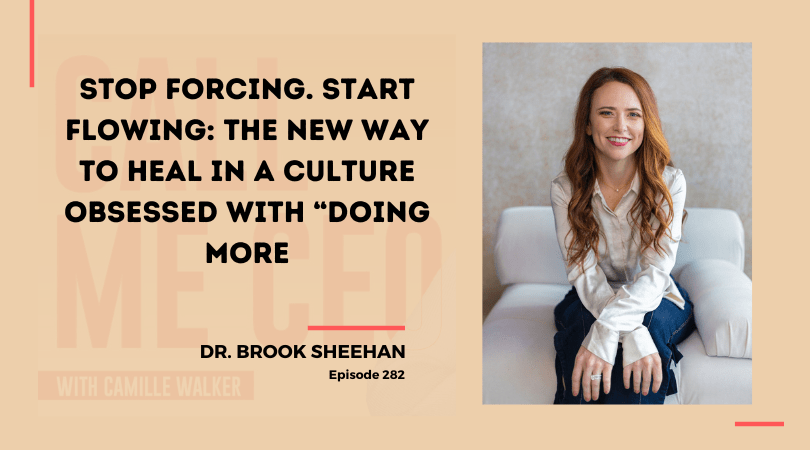
When life feels like a string of checklists, late nights, and “shoulds,” it’s easy to believe more force will fix it. Yet what many high achievers discover is that pushing harder widens the gap between effort and outcomes. The conversation with Dr. Brooke Sheehan reframes health and performance through a simple but radical lens: your body already knows what it needs, if you’re willing to listen. Her journey from financial accounting to chiropractic care and functional healing began with an intimate motivation—preventing birth complications linked to her own mild cerebral palsy—and evolved into a practice grounded in curiosity, respect for biology, and a faith-filled appreciation for the body’s intelligence. The premise is disarmingly practical: ask better questions, get better answers.
Dr. Brooke describes our health as a tangled ball of yarn rather than a straight line from symptom to solution. Headaches might begin in the gut. Skin issues may reflect overworked lungs. Chronic fatigue can trace back to emotional strain. The task isn’t to yank at one thread; it’s to gently find the lead strand and follow it with patience. Her Body OS framework—pause, connect, ask, adjust—teaches exactly that. Start with a short pause to switch from stress to presence; connect by feeling into your chest to sense a yes or no; ask a small, concrete question like “coffee or tea?”; then adjust based on the felt response. Over time, this muscle of micro-choices builds trust and clarity, replacing reliance on generic protocols with personalized decisions that stick.
One of the most surprising insights is how burnout hides in plain sight. We usually picture exhaustion, irritability, and brain fog. Dr. Brooke adds a lesser-known signal: persistently dry skin. Under stress, the lungs work harder to regulate blood pressure and respiration, drawing moisture from the skin. No serum can outpace a nervous system stuck in fight-or-flight. The fastest lever is also the cheapest: your breath. A simple 4-7-8 pattern—inhale four, hold seven, exhale eight—shifts the body toward parasympathetic calm, restores prefrontal function, and creates space for better choices. From that calmer baseline, the next steps feel smaller, more doable, and more aligned with the day’s energy rather than an idealized routine.
Women, especially mothers and founders, benefit from honoring cyclical needs. We don’t operate on the same hormonal rhythm every day, and training, nutrition, and work output should flex, too. Instead of forcing the same workout or meal plan, use a this-or-that check-in to choose what fits your current phase: heavy lifts or a walk, protein-forward lunch or mineral-rich soup, focused deep work or creative planning. This fluidity isn’t slacking; it’s precision. Dr. Brooke’s own story illustrates the power of borrowing belief during hard seasons, then building self-trust through small, repeatable wins. The goal isn’t to know everything—only to ask the body and adjust.
Beyond tactics, there’s a deeper synthesis of science and spirituality. Dr. Brooke’s “Talk to Me Body” affirmation deck pairs anatomy-informed prompts with scriptural grounding and reflex points you can activate for organ support. It’s an invitation to move from fear of symptoms to faith in design. While labs, tools, and therapies have their place, the most reliable compass is internal. Start by choosing one daily decision to personalize, breathe when overwhelm spikes, and track how your body responds. The promise isn’t perfection; it’s partnership. When you stop forcing and start listening, flow follows—and so do better health, steadier energy, and more meaningful work.
Resources:
Learn more at www.drbrooksheehan.com
The Ultimate Time Audit & Productivity System (Freebie)
Grab it here: TIME AUDIT WORKBOOK
How to Hire Your First VA for $27
Get it now: GROWTH CHEATSHEET
Discover Your WHY – Free 5-Day Workshop
Sign up for free here: DISCOVER YOUR WHY
The Mom Balance Playbook (Freebie for Managing the Mayhem)
Download here: MOM BALANCE PLAYBOOK
Hire a VA or start your VA business here: https://camillewalker.co/
5-Minute Meditations for Kids Podcast
Listen & subscribe here: APPLE SPOTIFY
Top 100 Mompreneur Podcasts: https://podcast.feedspot.com/mompreneur_podcasts/
Connect with Brook:
Follow on:
Instagram: @drbrooksheehan
Facebook: https://www.facebook.com/FIT4MOMHQ/
Connect with Camille Walker:
Follow Camille on Instagram: www.instagram.com/CamilleWalker.co
Follow Call Me CEO on Instagram: www.instagram.com/callmeceopodcast
Brook: 0:00
When I'm working with patients one-on-one, really what I'm doing is dialoguing with their body. So you and I, Camille, are having a conversation. I'm using English, you're using English. When I'm saying I'm dialoguing with the body, I am not talking to you. I'm talking to your body.
Camille: 0:24
So you want to make an impact. You're thinking about starting a business, sharing your voice. How do women do it? Did it handle motherhood, family, and still chase after those dreams? Listen each week as we dive into the stories of women who know. This is Call Me CEO. Welcome back, everyone, to Call Me CEO. This is Camille, your host, and we are going to be treated very beautifully today. We're talking about flow, how to not push so hard that you want to break, but actually live in the flow of your life. We are joined by Dr. Brooke Sheehan. She's a chiropractor, functional health practitioner, and a mom who's here to help us stop forcing and start flowing. So if you've ever felt like you're doing everything right, but still running on empty, this episode is for you. I think there are all stages of time where we feel that way. And we want to speak to you about that specifically. We're going to talk about how to lead your business and your life from a place of peace, presence, and true power. So thank you so much, Brooke, for being on the show today.
Brook: 1:32
Camille, thank you so much.
Camille: 1:33
I'm truly honored. Well, it's exciting to have you. I think we we talked about this a little bit before, where, you know, going to a chiropractic school, I feel like there are two schools of thought where people who are very much Western medicine, they're like, oh, they're quacks. And then there are other people who are like, no, there's so much beyond that, where it's about the functional approach to your body and also the energy of your body. And I really appreciate that. In fact, I had a mom who helped me so much when I had children who had chronic ear infections. And my first two children had to get tubes put in their ears after multiple ear infections. And a friend said to me, Hey, you should go to a chiropractor and do some adjusting because the eustache tube isn't developed yet. They just need realignment to help with the drainage. And then you're not, you know, giving your kids so many antibiotics. And I thought, well, gosh, that's interesting, but worth a try. And it's an investment up front because you have to see them multiple times. And then my last two didn't get more than five ear infections all of their youth, only a couple. And it was, I wish I would have known that sooner. And so I feel like there's so much strength in mothers sharing what they know about Western and Eastern medicine and also different professionals. And I anytime I talk to young mothers now that have babies with ear infections, I say, Have you seen a chiropractor? Anyway, that's like neither here nor there. But just a little nugget of help. If you have a young one with ear infections, consider a chiropractor. So, Brooke, tell us more about you, where you live and your family, and then we'll get into the story about how you got into functional flow in your offerings.
Brook: 3:23
So thank you so much, uh, Camille. I am a mother of a 14-year-old. I got married two and a half years, remarried two and a half years ago, to a lovely man. Uh, we have two stepchild, well, I have two stepchildren, so he's got two kids of his own. We live out here in San Diego, California, beautiful, sunny San Diego. I was telling you in the pre-show that I'm freezing and I had my space heater on, so I had to turn it off and get all, you know, ready for the interview. So thank you.
Camille: 3:53
Yeah. So tell our audience a little bit more about what motivated you to be a chiropractor, first of all. Like how was that something you'd always wanted to do, or what was that journey like?
Brook: 4:05
Yeah, this is gonna be a wild one. I my background was financial accounting. And I understand that that is complete left field to what I am doing now. I will say though, I was born into a family. Although I didn't know this side of my family, my dad's side of the family were all medical doctors. So my grandfather was dean of New York Medical School, his uh brother uh discovered a syndrome called Sheehan syndrome that's still in medical literature today. Wow. And their entire family were all in the medical profession. My dad's grandfather, his aunts, uncles, everybody. And again, like I didn't know that side of the family, so I didn't grow up that way. I grew up actually having chronic ear infection. So it's like interesting you talked about that in the beginning. And I was on antibiotics every single time, every single time, to the point that I developed an allergy to amoxicillin, where even when I was giving birth to my daughter, I had to have that bracelet. Like she's got an allergy to any sort of you know, cillin. So don't put her on any of that if something, you know, happens. And so anyway, uh flipping from financial accounting to chiropractic was the journey of me getting pregnant with my daughter. So one of the things, and I don't share this a lot on podcasts, not for any other reason, just because I feel like I talk about it a lot in my personal life, but I have a mild case of cerebral palsy. And cerebral is a gross motor movement disorder. So it's a loss of oxygen in the brain that happens during the birthing process. So as you're coming out of the birthing canal from mama uh or you know, C-section or something like that, if you have loss of oxygen to the brain, cerebral can happen. Now, gratefully, mine only affects 5% of my body. So it affects my right arm and my right foot. And so growing up, I used to do a lot of it's been gotten a lot better, although it's not a progressive disease, nor does it get better. But I've been able to kind of work my muscles and work my uh limbs to where they function much better. But when I was growing up, my right arm would be flexed upwards, like towards my shoulder. Like I would hold it my hand up towards my shoulder and I would walk on my tippy toes. Growing up with that and being ridiculed and made fun of for every time you walked, when I got pregnant with my daughter, naturally I started to like go, okay, what can I do to potentially prevent this from happening? And my mom was in labor for 29 hours with me, and the doctors raced in once they discovered that I was losing oxygen, raced and put oxygen on her. So I'm like, how can I be as proactive? You know, because I I felt like, well, there must have been must be something I can control. Now I understand, you know, for all the years women have been giving birth, no matter like you doing, staying in your lane and being so natural or doing all the things, all the right things, things can still go wrong. So I'm not saying we are in control, but I felt like let me learn different things I could do. And so I started taking natural childbirth classes. Like, how can I not have any interventions? What can, you know, happen? And one time during these classes, we had a lactation consultant come in. And I have never heard of chiropractic for babies. I've never even heard of chiropractic for for pregnant women at this time. And my mom had been seeing a chiropractor for about 10 years prior to this. And funny thing is, his practice is a wellness clinic, kind of like what you were talking about when you brought your kids in. Those are wellness clinics where they're not just looking at low back pain, they're looking at the whole system holistically. Yet she she didn't really see it like that. She just walked in for her low back pain and didn't even think to tell me about it. But this lactation consultant comes in and talks about chiropractic for newborns and pregnant moms. And I'm like, oh my gosh, why am I not utilizing that tool and putting it in my tool belt towards having this natural childbirth that I'm looking for? So started seeing the chiropractor she was seeing. And he's like, I can't believe you've never seen a chiropractor and you have cerebral palsy. Like, this is like, what? You know, he was so like taken aback by that. But he was the voice that was in my head at such a very like trying time in my life because at that time I was also in a very unhealthy relationship with my, you know, soon-to-be daughter's father. And there were there were a lot of moving pieces, but over like a two-year time frame. I mean, he adjusted me during my pregnancy, he adjusted me after, he adjusted my daughter. I did have the natural, beautiful childbirth I was looking for. Thank the Lord. Um, but you know, I it it is what kind of transitioned me into that, but it was his voice speaking over me every single time I walked in there. You need to go to chiropractic school, you need to go to chiropractic school. I'm like, Dr. Matt, you're insane. I have cerebral palsy. Remember? I have cerebral palsy. It was like the the curse. I would speak over myself over and over and over, that limiting belief that we put in our heads. That's you guys. I went to chiropractic school. I was in no remedial classes. I took all the exams. I adjust, I can do all the things. Like, so a lot of times we tell ourselves, oh, we can't do this, when in reality is we haven't pushed ourselves to those limits, or we don't even have the belief in ourselves that we have to sometimes borrow someone else's belief. I know, you know, this is my story, but I just wanted to kind of share that nugget as well, like you did in the beginning about ear infections, that we we have to sometimes carry someone else's, borrow their belief in us to really push forward and push through.
Camille: 10:00
Ooh, I love that. That's so true though, because I feel like we do carry stories around with us that are limiting and a lot of times aren't even true. And to challenge the truth of why why you think that? What's the curiosity and the question of where that story even came from, you know? So that's incredible. So you went to school and educate me because I don't know, is it four years? Is it six years? How long of school is that?
Brook: 10:30
Yeah, it is four years. So four-year program. Um, you have to have undergrad requirements taken care of. And that I didn't have uh when I went to chiropractic school. So when I made the decision after he spoke into my life for two years, and I finally said, okay, I'm gonna, I'm gonna at least check it out. I'm gonna see what this is all about. Uh, I had to do a lot of undergrad classes in anatomy, biology, physiology, all of the ology classes, medical terminology, all of those kind of things that were gonna prepare me because what is a balance sheet? What is knowing debits and credits and all those kind of things in Microsoft Excel? How is that gonna support me in chiropractic school? I needed to take all of those extra additional credits that were needed. Now I know I want to say because I know some people might be listening and going, oh, well, you could go into chiropractic school with a bachelor's degree in anything, which there is truth to that. I didn't have my bachelor's in accounting at the time. So I chose to take courses that were going to benefit me in the long run. So when I showed up, I wasn't coming in blanket, zero, you know, no knowledge of anything.
Camille: 11:44
That makes sense. Yeah. Okay. So you come into school, you become a chiropractor officially. And what does that look like for you in terms of, okay, I have this now, this is what I want to do.
Brook: 11:57
So come into school, graduate.
Camille: 12:00
As a new mom. You went through school as a brand new mom, too. Because you waited two years. So yeah, that's okay, Camille.
Brook: 12:07
I gotta back up the story a little bit. Yeah, please tell me. I I I think this is really gonna be helpful for some of the moms who might feel like, well, my circumstances are just too overwhelming, too crazy, too dark, too whatever, and I can't move forward. So while that was such a good, feel-good little podcast episode, I can't do it. Let me tell you right now, it was the biggest walk of I it was really dark. Okay. So I will, I will tell you, I had my child in 2011. I didn't make the decision to go into chiropractic school until about 2013. Then I had to, like, I was working full-time in my accounting uh job. I was taking night classes at a community college here in San Diego, like after work to get those credits. I was in the middle of a nasty divorce. Okay, so we're we're already separated, like all this, these things are going on. I I've got this toddler. Um, and it was so 2013 started getting the credits, didn't finish until the end of 2015. And I was like, I need to parapractic school, at least the one that I went to, works in quarters. So I could have ended in December of 2015 and went right away in January. And I was like, I just need to take a couple months off of school, get ready to start. The whole plan. So I'm here in San Diego. The whole plan was I was going to take her to the Bay Area. Now, just for reference for anybody in the country, the diff the distance between that is about an eight-hour drive. So the plan was to take her with me when I left to chiropractic school. At this time, she was about four years old. Well, my ex-husband had this idea that we were going to get back together and was all for the plan until he realized, oh, wait, I'm not going with you. You just want to take her. Then I ended up in a huge court thing going on. So I didn't know what was going to happen in those 90 days that I decided to take off, right? From January to April. Uh, because I didn't actually put my start date until April of 2016. Those 90 days were so tumultuous. Like I it's I I stand here talking to you today, and I'm just like, wow, like looking back on my life, like how I got through that. I mean, I did have a lot of family support and whatnot. But long story short, is she did not get to come with me. She had to stay in San Diego. And the reason for it, not that I was a bad mom, not that he's a bad dad, but my my attorney was like, you are fighting an uphill battle. If you decide to take her, we're going to be in trial and all these things. She was born in San Diego. Your family's in San Diego. Her school's in San Diego. Everything she knows she's in San Diego is in is in San Diego. She was four years old. And I had to make this decision. Do I allow this man to hang a metaphoric noose around my neck and force me to stay behind? Or do I make a better life for myself and for my child moving forward? Okay. So I left to chiropractic school. As I mentioned, we were on the quarter system. I was home one time a month. So I was, I had frequent flyers at Southwest, like no other. I mean, I was in and out of airports like all the time. But I was flying home once a month. And then at the end of every quarter, we would either have two to three weeks off or like a 10-day period. So every single break I had, I was here in San Diego. I told professors, classmates, school officials, all the people. I said, if I ever feel like her and I's emotional connection is breaking, I'm quitting school and I'm moving back home. Luckily, that never happened. She was able to spend every single summer vacation, her entire summer vacation with me up there in San Francisco. And it's still an experience. She's 14 years old now. I graduated when she was eight. Um, it's still an experience. She still talks about that to today, even all the memories that she had, all the fun things that we did while she was there. And so that would have never been something that I would have been able to give her had I not had to make those difficult decisions.
Camille: 16:09
Wow. Wow. That's a huge stack against you. I mean, just think just going through court custody period is a lot. Going back to school, being a first-time mom, what sustained you through all of that to keep going?
Brook: 16:29
Man, that that is such a great question because I honestly I don't know. I mean, I have a lot of faith right now, and that my faith didn't really get started getting developed for the last like three years or so. I at that time in my life was just really, like I said, like walking through a dark period, feeling a lot of depression and all of the feelings that I'm sure a lot of people walking through dark periods in their life have felt. But I I think really what anchored me down is knowing that this human being needed mama and that I wasn't here in chiropractic uh in chiropractic school to play. I was here to focus, right? There was a lot of people that came in that were just young and I came to chiropractic school when I was 30 years old. You know, they're right out of undergrad, going into the next thing, wanted to like party and all that. That wasn't my thing. It was just like I'm focused on getting back to San Diego as fast as possible. I'm gonna enjoy myself and I'm gonna learn and I'm gonna, you know, hang out with people, but not to the extent that everybody else was. So, really what kept me grounded was knowing that she was here and she was proud of mama and that, you know, she she was looking forward to mama coming home. So it was just one thing that we had to get through day by day together.
Camille: 17:46
Wow. So you graduate, she's eight years old, and you're San you're in San Diego now. So does that mean that you were in the Bay Area going to school full time, and then you made your your permanent residence back in San Diego when she was eight? Is that right?
Brook: 18:03
Yes, that's correct. Okay. I was raised here, yeah.
Camille: 18:07
Yeah. So you're back in San Diego, you decide you want to start a business. How does this turn into what you've created now? Take me to that time.
Brook: 18:17
Absolutely. So, in between this time frame, between me leaving to chiropractic school and me getting out of chiropractic school, I had started seeing that doctor that I was sharing about who was really inspiring me to go to chiropractic school. And he was an incredible adjuster. He knew, you know, he could adjust you without even having to think about things and crack, crack, crack, crack. And I love him. Like I have a lot of respect for him. We still are really good friends today. But I reached a point where, and this is the point in my story. Like I went and I mentioned this in the beginning, you know, where I was on antibiotics for every ear infection. And I just grew up in a very medical conventional household where it was just Tylenol. Any any ache in your body, you just take drugs for it. You don't, there wasn't anything natural. My grandma was the one who would make meals from scratch or like actually make meals, but my mom was taking us through drive-throughs and so forth. So I was completely disconnected. And then when I found chiropractic and I started learning all these natural, like ways of living and doing things and all this stuff, I really swung this pendulum to the opposite extreme. And I became so obsessive over everything. I'm like, oh my gosh, don't put that toxin. Oh my gosh, don't let that touch your skin. You know, I was like, I was that girl, like with my blowhorn on the side of the road, like, you know, don't eat here. This is toxic food. You know, not really, but I mean, that was what a lot of my friends and family, like Jeez Brook, like, I'm just trying to live my life. And I'm like, it's so horrible for you. I went extreme and I got super obsessed. So, in that period of time before, like when I was in that state where I was like, okay. I've learned a lot of natural health stuff. I had my natural childbirth. I like ever did everything like how I wanted it to go. And I was get in the middle of getting those undergrad because there was like two years of figuring the natural world out and then going to actual chiropractic school that I actually came into contact with this doctor who I was like, I started to get to this point where I was like, there's something more wrong with me. Like I'm getting adjusted three times a week. There's, I know that my there must be something wrong with my brain. There must be something wrong. I mean, I'm like doing all the things. I was listening to podcasts on podcasts, on podcasts, watching all the Instagram gurus, taking 28 supplements, literally 28 different supplements, all these things, trying all this stuff. And I still felt miserable in my body. So I found this practitioner, got introduced to it, and this practitioner. And I really believe like he had this gift at being able to read the body, to dialogue with the body, to talk to the body. And it was incredible to see not only did he transform my life by, hey, 28 supplements. This is ridiculous. Your body is not asking for all of these. Here's the two that you actually need, which were two that I actually had, but you're taking the wrong dose. You need more of this, you need less of this one. And I made those slight adjustments and things like transformed dramatically. Now, my sister, my younger sister, the baby of the family, she had just gotten diagnosed with ulcerative colitis, which is bleedy gut, like essentially, like you're just stools are all bleedy and gut issues and things like that. And within maybe six weeks of starting to see him, like she had no symptoms. I mean, she couldn't go 20 minutes without having to use a bathroom. So her and I were like, whoa, this is absolutely incredible. I was already on the route to do chiropractic school. Then I was like, I want to do chiropractic like this guy. Like, I want to learn what this guy does. And for those of the for those of your listeners who might be familiar with kinesiology, like applied kinesiology, clinical kinesiology, muscle testing, he was doing a lot of that in his practice. And so naturally, you know, the times that I was home in San Diego when I was here to see my daughter and she was at school and I was on an off time, I would go and shadow in his office. And I became a patient of him, his up until I left chiropractic school. And so graduated chiropractic school, went to work for him with the intention of like taking over his practice. And it just didn't work out that way. And God set me on this other journey where I am doing what he taught me in that practice. I am dialoguing with the body. I'm learning to, or I'm teaching people how to learn to listen to their body so that they don't have to be on that crazy train extreme side of things where you're doing red light, you're doing all these stimulators, you're doing, you're trying to biohack every step of the way. There's nothing wrong with that. The thing is, is when we know how to actually ask our body questions and get responses from it, then we can say, is this the right tool for me? Is red light therapy right for me? Okay, great. Is it right for me for three minutes, five minutes, 10 minutes? Right. Like every one of these companies, they have, you know, well, this is the protocol. You have to do it for 15 minutes, this amount of time, you know, regardless of who you are. Or, you know, they try to tweak it differently. And I'm what I'm saying is your body does talk, it does speak to you. And if we learn to listen to it, it will tell us and and really guide us in how to how to do things.
Camille: 23:43
Are you ready to reclaim your time and finally focus on the tasks that actually grow your business? Whether you're looking to hire a VA or thinking about becoming one, I've got the perfect solution for you. If you're overwhelmed with your business, I personally connect entrepreneurs with highly trained virtual assistants, graduates of my 60 days to VA program, so you can confidently outsource and scale. Or if you're looking for a flexible, profitable business from home, my 60 days to VA course gives you everything you need to have to become a successful assistant without the trial and error. Head to camillewalker.co to get started today. Whether you're hiring or launching your own business, I'm here to help you make it happen. You can also grab this link below and schedule a free discovery call with me to see if it's the right fit for you. I love that. Okay, so you call yourself the body whisperer. So I want to talk about what does that mean in our own personal journeys of starting that work? And then also how can we increase that awareness? And what I also, before you say that, I'm like, what are the two supplements? I'm so curious because I feel like that is such a thing right now, where it's like, you are short in all these things. Do you need to take all the things? What are the two before you get into that question?
Brook: 25:03
Okay. The two was a GABA supplement, and the other one was a methylated, like homocysteine to break down, because I have MTHFR. Some of your wellness nerds may know even what that is, but it was a methylator to break down homocysteine, that whole cycle. So I was taking actually too much of that, which was causing my brain to overre respond. And then I was taking too little of the GABA. But that was for me personally, you know, I'm not even taking those two right now in my life. Like I'm interested, you know, I uh yeah.
Camille: 25:37
But that's okay. I have someone I want you to talk to after this because they're they're struggling. But okay, so let's go into body with the body whisper. What does that mean to you? And then how do we develop that in ourselves? And what does that look like to be in the flow of that?
Brook: 25:51
Yeah. So, okay, so but the the term body whisper, like when I'm working with patients one-on-one, really what I'm doing is dialoguing with their body. So you and I, Camille, are having a conversation. I'm using English, you're using English. When I'm saying I'm dialoguing with the body, I am not talking to you. I'm talking to your body. And I'm figuring out what is making your body so upset. Like, why is it so angry? Right. So a lot of my patients, like I will say like 99% of my patients are coming to me with one on referral basis because of their friends or their family members are like, oh my gosh, I don't know how she did it, but she did it.
Camille: 26:30
Which is amazing. Congratulations. Thank you. That's when you know you're really good.
Brook: 26:34
Um, and like the other thing is they're coming with really chronic conditions where they've seen other practitioners for it. You know, they've seen the gut specialist, they've seen the hormone person, they've seen this, they've seen that, and not being able to get results. And my whole thing is well, this is how I try to break it down in simple terms. If you think about your body as like a big old ball of yarn, and that yarn is so just knotted up, like it's almost Christmas, right? Maybe people are pulling their Christmas lights out from the attic, and you're just like, okay, what where do we feed this, you know, starting point into to like really get this more coherent and organized? That is how the body functions. It does not function in a linear state. It is not like, oh, every bit of your symptoms because you're having headaches is only because you're you're there's something going on with your brain. No, every system is connected. And I think most of us can say, yeah, we agree, every system is connected. But what we don't realize is we have to take that big tangled up ball of yarn and start to like kind of feed it through and figure out. So a lot of times, and I know I'm getting into the nuances here. So when I say body whisper, let me just back up really quick. When I say body whisper, I am acting as that person's guide to really unravel these pieces. Now, because there's a lot of nuances, there's sometimes where people need a guide like me to help walk them through and get to the bottom of why they're having chronic gut issues and they've done every single cleanse or done every single protocol right out there. It's like, well, let's figure out what your body actually has to say about it. But here's the thing is through body OS, which I've created body as an operating system. Catch that body OS. There's your accounting company. Um, the body as an operating system is people can learn to do this on their own. And there's a four-step framework. So within the body OS body of work, I tell I talk to people about health in four pillars. So just because you don't physically have any symptoms, or maybe you do have physical symptoms, you could also have spiritual issues, you could have emotional issues, you can have mental issue issues. There's four big pillars to health. And, you know, outside of physical symptoms, there could be other areas, you know, where you're not feeling good about yourself or what you're doing in your life, or you don't feel fulfilled, all these things, right? Those can cause issues physically to your body. We don't understand a lot how emotions play a factor, right? But then within that, then there's four steps. So the step is to pause, to connect, to ask, and adjust. And a very simple way, I say, you know, you when you when you're about to make a decision, and the thing is here, when you're learning this, this is like building a relationship. Camille, you and I are meeting face to face for the very first time. We've had some email exchanges, we've gotten a little, you know, chance to know each other, but I don't know what fuels you. I don't know the desires of your heart. Like I know about you as a mom and things like that. But as we build relationships, like if I talk to you every single day for 20 minutes on the phone, that relationship is going to build stronger and stronger and stronger. And I'm gonna know more about you. I'm gonna know what you like, what you dislike, all those things. I tell people when you're learning to build a relationship with your body, when you're learning to listen to it, instead of crowding out its own voice to all of the external noise that you're hearing because you're looking at, you know, the Instagram influencer that's saying, take this pill, do this protocol, do this, this, this, right? And there's all these 30 seconds, rub this, and you're and you're doing all these things without really listening to your body. When you're doing that, understand it takes time to build this relationship and you're not giving your body difficult questions. So I call this this or that when you're starting out. This or that. Every single morning, I wake up and I drink a cup of coffee. That is my this. But what is my that? My that could be a cup of tea, it could be lemon water, it could be something else completely like a juice. And you can use these questions, this or that, for everything that you normally would do. So if every single day you get up and go for a walk, I I tell you, use a different that for that particular day. It could be body weight exercises, it could be going to the gym, it could be doing a Pilates class, it could be doing anything else, but you have to ask simple questions. And some people get super overwhelmed and they're like, Dr. Brooke, I just I don't know what answer I'm getting. Okay, but come out of your head because your head is where you're you know, you're you're getting all caught up into the overwhelm. Come back into your body, feel into your chest, ask it the question, coffee or tea. Wait 15 seconds in that pause, like maybe take a couple dip deep breaths, and in that pause, ask it, ask the question. If you don't get an answer within 15 seconds, drink the coffee like you normally would do, and then start again the next time. It takes practice, but when you take that pause and then you take the moment to connect with yourself and then ask a question, you can then get information.
Camille: 31:53
I'm losing your audio just a little bit. Sorry. No, it's just quiet, so keep going. Okay. You know what?
Brook: 32:01
Maybe I hit this.
Camille: 32:02
Yeah.
Brook: 32:02
Um, is that better? Okay. I think I did. Um, I'll go back to the connect. So when you pause and take that moment with yourself, then you can connect and start to like really kind of feel into how your body's responding to that. And then you, you know, ask those questions, this or that, coffee or tea. And over time you can start to adjust. You can start to like really see patterns, like, wow, like I like I wake up some mornings, like I know exactly what my body's asking for without even having to sit in it for a second because I've been doing this for so long now that I'm so sensitive to, oh my gosh, like, wow, I was totally reaching for grapes and it's like screaming at me, like, get the strawberries, you know, something like that. But it does take time. This is something I do teach. I do um have some free stuff people can download, you know, to really kind of work through um some of that pause, connect, ask, and adjust framework. But yeah, I know that was a long-winded response, but that's the end.
Camille: 33:05
No, no, I've I'm actually familiar with doing, I mean, I feel like we have intuitive eating that we have overridden for years because when I was in, I was actually had um nutrition classes that I was in college with dietitians, it was part of my degree, and they did a study where they would serve the same lunch to adults and to children. But what the adults and children didn't know is that the same foods actually contained different caloric quantity, but they looked the same. So people would get different different things. And what they found is that children would adjust for that by how much of the food that they ate, depending on how caloric the food was that looked the same, versus the adults that they would eat all of it, no matter what, which is interesting because it's that intuitive of like, oh, am I full? Which is another way of talking to your body, of really stopping and listening. But then I've also heard this concept of a this or that, and if it's one thing your body kind of like leans towards it. So what is it or how do you suggest that people know which way to go? Is it just like an inner knowing? Is it something that your body physically like leans toward? Like what is it that you suggest that people start with in that regard for getting the answer?
Brook: 34:28
That's a great question, Camille. And yes, there is the falling forward or like, you know, picking up something at the store or supplement. And does my body move forward? Oh, that's a yes. Does it move backwards? That's a no. You can absolutely do those. Um, the thing, the way that I teach it is really to start getting grounded more into that heart space and getting out of the head space because it's in the heart space that your body's actually giving you the answers. It's where you're that inner knowing, like you said. And the reason that I teach it that way, and yes, it may be the more difficult way at first to pick it up, but it is better in the long run because once you really start to develop this and you get a lot of clarity as you're going through it, then you're not needing to have to hold on, let me sit down the baby, let me get my car keys on like let me, you know, and and hold it to your chest and move forward and backwards. You you have every single, you you can have all your limbs completely unusable and you can know in in an instant, you know, whether you need to go for that five-mile jog or whether you're, you know, needing to just go for a walk, you know, because a lot of times we feel pressure to do things. And this comes back to the whole flow thing, right? Like living in a state of flow. We feel this pressure, this external pressure, like we're not gonna get the results unless we are eating chicken and broccoli every single day and going to the gym for two hours. And unless we're doing those three things, chicken and broccoli in the gym for two hours, we're not gonna get results. It's like that's not, that's not the way that the body's been designed. That's not how we are intended to live. Our bodies do love diversity. So creating that sense of flow and not feeling all this overwhelm that you're not you're lacking because you're not doing.
Camille: 36:24
And yeah. I love that there is so much more information about women's health, especially where it revolves around our own natural cycle in regard to our flow and our time of the month and what it means and how having that intuitive knowing whether it's what foods your body is craving or what movement or rest you're needing is so much more empowering because we don't work like men, where the 24 hours that they lived are the same that they lived yesterday in terms of, you know, the way that their hormonal cycle is for them. Ours changes and it affects our needs nutritionally and our needs for movement. So I think that that I love that that is the approach to this. So many of the moms listening are high achievers who feel exhausted despite doing all the right things. So, how would you help them identify when their bodies are signaling burnout or misalignment? Because as moms, we are giving so much, or you know, as business owners, there's always something that needs us. So what would you say to them who are feeling maybe disconnected from their needs and wants because they're so they're depleted?
Brook: 37:41
Well, yeah. So one of the big things that I do not believe that a lot of people really think about when it comes to burnout is so we think about, you know, well, yes, we're exhausted, we're burning the candle at both ends, we're doing the laundry, we're trying to run our business, we're taking calls while we're running to the kids' schools, all of the things. And that burnout is totally real. So taking it one step back before I get into this, um, before I say this thing of the signal that the body gives. But when we actually take a moment just to freaking breathe, and I'm sorry I said freaking, but I need to have people understand, they need to breathe. Okay. You may be so overwhelmed that you're like, I can't even take 30 seconds. You need to prioritize yourself in those 30 seconds, like for your body's sake, because the reality is just like we don't drive our car on empty, our our vehicles or batteries might get to the very end, the gas light come on. There ain't no way we're gonna get 500 miles. Like, we're not just gonna push our vehicle to get to that destination. Eventually, it's gonna be like, you know what? You didn't take care of me. Okay, take the 30 seconds, take the 30 seconds, please. I implore you. And it all it needs to be is four seconds in, seven second hold, eight second exhale. And do that a few times for the 30 seconds, and you will literally just kind of help reset that nervous system to get more into that parasitic parasympathetic rest and digest. Because when you are running at both ends, when you're pushing, pushing, pushing, your prefrontal cortex, which is your like reasoning center, helps you with your behavior, your emotions, all of it, that shuts off because you don't need that in survival. You don't need your reasoning, you don't need your emotions in survival. You're just running from a tiger. So getting yourself into that rest and digest. So here's a big signal that I've seen with patients, I've seen across the board that people don't identify with burnout, but it it's a big thing is dry skin. So we could be drinking a lot of water, we could be doing all the lotions and the potions and the treatments and all the things, and we can't figure out why our skin is so dry. Your lungs pull in so much of the moisture. From your skin to help regulate your lungs. Your lungs, not only are they big blood pressure regulators. I mean, we think about them like, oh, our breath. Yes, they regulate our blood pressure. So if we're running, you know, high blood pressure, those lungs are working to work along with obviously the heart and the kidneys to bring that pressure down. So they're working in overdrive. They're gonna pull the moisture from the skin. So no matter what you do, that skin's gonna be dry.
Camille: 40:28
This is so interesting because I just interviewed someone yesterday who was a scientist, immunologist who just developed a skincare line. And she was talking about how stress affects the skin, which is all a part of the function where the beauty industry isn't talking about that. So make sure you check out that episode because her her skin product has is so much connected to what's happening in the entire body. And so to hear you confirm that on the other side is so interesting.
Brook: 40:59
Yeah. It's big, it's a huge thing, you know. And as women and as moms, like that is where we tend to prioritize a lot, unfortunately. Like we're just like, oh, we're you know, we're aging, we're looking older, we gotta, you know, make our skin look better. We can make our skin look better by practicing a lot of things that will help the body internally. Like you were saying, like her skincare line is addressing the things that are going on internally as well, not just lotions and potions and treatments. Yep. And we talked about breath.
Camille: 41:28
That was her number one tip was breathing. Yeah. Isn't that crazy? She's it's free, it's breathing, it's taking time to connect with earth and your body and the presence of being here. So I love that I have these conversations back to back because these are resources that are available and free to us. And it's slowing down and hearing what is happening and what our body is telling us. And in both conversations, it was the same answer for similar but different problems, you know, like professional doctors, because she's a doctor of science and you're a doctor of chiropractic. That's so fun. I love that it all comes down to that. So, what are some daily or weekly practices that you like to do to stay connected with your body and that those who are listening can do the same?
Brook: 42:17
Yeah. So, like I said, you know, I've built up this relationship with my body over time. And so it looks a lot different for me now, this many years in versus, you know, starting out. But daily practices is asking those questions, this or that, not getting yourself super overwhelmed by the response. And maybe you don't feel like you got a clear answer. And I I mentioned earlier, you know, if you don't feel like you got a clear answer, go back to your coffee or go back to what you normally would do. Maybe on a certain day you just switch it up because, right? Like you instead of reaching for the coffee, you go for the tea or doing the workout or picking something different for lunch. Like the whole idea is really doing things outside of what you normally would do, right? Like when especially in a state of overwhelm when when life is just lifing and you're just going, going, going. We need a switch up of daily activities to really help bring us back also to center us, like, oh, we actually have to think about this. We're not just like going to our kids' school the same exact way or going to work this way or doing this this way. We're we're gonna switch it up. And I think practicing those daily steps, it doesn't take a lot. Like you said, it's free even to do. It's just being mindful about where your feet are when your feet are somewhere. A lot of times we don't even think about that.
Camille: 43:38
We're just yeah, yeah. Yeah. So you created an affirmation card deck called Talk to Me Body, which blends faith and body awareness beautifully. So talk to me about how do you see spirituality and science working together in healing?
Brook: 43:55
Oh, such a beautiful question. So I mentioned the four pillars: physical, spiritual, emotional, mental, and all four of those pillars need to be vibrant and well in order to really live out full healthy lives. And when we're not doing well, and and it no matter what kind of faith you follow, right? No matter what, faith needs to be like we have to have faith in something. I know, you know, a lot of us don't think about it, but we have faith in gravity. We know we're not gonna have to think about like, oh, are we gonna float into outer space? Like, no, gravity is gonna hold us down. So being anchored to something, to like something greater, right? Like in the moment when I was away from my daughter, I had to anchor myself into knowing she's looking for mama, right? So it's important to not only take care of our bodies physically or put all the skincare potions on and do all the things, but it's it's important to have purpose and find like our sense of belonging and what we're doing. And so with the Talk to Me Body card deck, the way this came about, uh, quick story, but working with patients all these years that I have, I have talked so many people off the ledge more times than I have ever wanted to, you know, having to remind them that yes, I I recognize you feel feel your symptoms. Where I'm not minimizing that, but your body is doing amazing things and it's responding because it's trying to actually keep other pieces together for you. And so this was really inspired on that notion of like getting people out of fear of their body and faith and putting their faith into their body that their body is like a masterpiece. It's miraculous. It's like Camille, our bodies are doing things. You and I have been talking for the last maybe 30 minutes or so. Our bodies have been doing so many things, breaking down proteins, building up proteins, helping with hormones, oxygen exchange, all the things to keep us going so we can keep doing this. And so this has been designed to just really help people learn the different aspects about themselves in a way where they can like really embody that. So the there's a total of 63 cards. The first 20 are from your body as a whole. So I am your body and these statements. And then 21 to 63 are individual pieces of your body. So I am your lungs, I am your kidneys, I am your stomach, you know, different parts. The other cool thing, yes, there's a scripture on every single card that correlates to that um organ or that your body, the body as a whole. The other thing is there's QR codes on the bottom of each one that takes you to a neurore reflex point to help you activate that organ. So when you're rubbing these certain points on your body, you're helping support your liver, you're helping support your kidneys or your adrenal glands or your large intestines and so forth. So I actually had a patient uh message me not too long ago. She goes, Dr. Brooke, I was having a lot of stomach pain and I I pulled the stomach card and I started doing the reflex point and it went away in 15 minutes. And I was like, that's so cool.
Camille: 47:04
That is so cool. Yeah. Yeah, that's so awesome. I think we could talk about this forever. In fact, I think I should have you back for another episode, specifically talking about that reflexology and those points and how we can communicate with our bodies because the more you know, the more you can grow. And I feel like there is so much inner knowing as our spirit, our soul. There's so much knowing that our body is trying to talk to us. And we have so much information, almost to the point of our detriment. I think sometimes with these phones that are in our hands all the time and they're telling us what we what we should know. And I learned so much. I mean, that's how I share this is of course, I love social media and the the internet and what a resource it is for education. But to take a step back and really to look at what you know, what your body and your spirit and your soul is telling you is so powerful, so infinitely powerful. So please tell our audience where they can learn more about you and your products and where they can continue this conversation.
Brook: 48:05
Absolutely. So everything is on my website at Dr. Brooke Sheehan. You can find the cards there. You can find more out more out about Body OS and my membership and all the things. I am on Instagram at Dr. BrookeSheehan as well. Uh, one thing I want to mention for those who might be listening and not grabbing things from the show notes, I do not have an E at the end of my name. So if you type in Dr. Brooke with an E, you will not find me. So uh I am one of the unique Brooks without the actual E.
Camille: 48:34
Yeah, that is a good tip. So that is B-R-R-O-K. She R O O K. B-R O O K, whatever I said. And then last name, she hen S-H E H A N. Yep. So perfect. Awesome. Well, thank you so much. And we'll make sure to link to that below. It'll be easy for you to grab there. And even if I spelled it wrong, it will, it will be spelled right there. I promise. So thank you so much for tuning in. And for anyone who has listened to this episode and has found it inspiring, interesting, motivating, please share. That is how this show grows. That is how women are inspired to do so many incredible things. Like Dr. Brooke, thank you so much for being on the episode and for sharing your knowledge with me. I feel like we could talk forever. So thank you so much for being on the show.
Brook: 49:23
Absolutely. My pleasure. It's been so fun.
Camille: 49:26
All right. Well, we'll see you all next time. And thanks for being here. Hey, CEOs, thank you so much for spending your time with me. If you found this episode inspiring or helpful, please let me know in a comment in a five star review. You could have the chance of being a featured review on an upcoming episode. Continue the conversation on Instagram at CallMe CEO Podcast. And remember, you are the boss.
Sign up to receive email updates
Enter your name and email address below and I'll send you periodic updates about the podcast.